
Hancock County Criminal Court Records
A criminal court record is the court case file kept after a charge is filed. In Hancock County, the Clerk of the Circuit Court / County Clerk keeps the record for criminal cases in the local trial courts. The case file can show the charging information, probable-cause material if public, bond entries, initial hearing, arraignment, plea, motions, orders, hearings, disposition, sentencing, probation terms, fines, fees, restitution, and warrant or summons activity when that activity is public. The charge itself is only one part of the criminal case file.
Hancock Circuit Court handles criminal matters along with probate, civil, juvenile, and domestic relations cases. Hancock Superior Court I handles serious felony criminal cases as part of its broad general jurisdiction. Hancock Superior Court II handles traffic infractions, misdemeanors, Class D felonies, and small claims. Because local case assignment can vary by rule, related case, and court order, a criminal search should use the case number or party name first, then confirm the assigned court on the case summary.
The Hancock County arrest records and court charges page focuses on the charge list and arrest-to-charge path. This criminal court records page focuses on the full case file, including hearings, pleas, dispositions, and sentences.
Search Hancock Criminal Court Records
Use Indiana MyCase for public Hancock County criminal court records. MyCase supports searches by case number, party name, attorney, citation number, and cross-reference number. A defendant name search can locate public felony and misdemeanor matters, but common names need extra care. The official search tips say a party search should start with last name or business name, and first name, middle name, or date of birth can narrow results. Case-number search is more precise when a summons, order, docket notice, or attorney letter lists it.
- Open Indiana MyCase and choose case search or party search.
- Enter the criminal case number when known, or search by the defendant's last name and narrow the results.
- Filter to Hancock County or the assigned local court when the portal provides that option.
- Open the case to read the case summary, charge list, chronological case summary, hearings, disposition, and sentencing entries.
- Request a certified copy from the Hancock County Clerk when an official criminal court record is needed.
MyCase is not a substitute for the official court file. The Indiana Judicial Branch help materials say many public documents are available online free of charge, but some documents are not online and older cases may have limited electronic access. Certified copies and unavailable documents come from the local clerk. For all case types, the broader Hancock County court records search path explains the clerk copy process and public access rules.
Hancock Criminal Case Flow
A Hancock County criminal case moves through several stages, and each stage can create docket entries. The first public case event is often the filed charge or charging document. The initial hearing or arraignment advises the defendant of the charge and can address rights, bond, counsel, and the next court date. Pretrial entries can include discovery, motions, continuances, plea negotiations, hearings, and orders. The case then resolves through dismissal, plea, trial, disposition, or sentencing.
Case flow: Charges Filed › Arraignment › Pretrial / Motions › Plea or Trial › Disposition › Sentencing
| Stage | What Happens |
|---|---|
| Charges Filed | The prosecutor files the formal criminal charge, usually by information or another charging document, and the court case opens. |
| Arraignment / Initial Hearing | The defendant is advised of charges and rights, and bond, counsel, plea, or future dates may be addressed. |
| Pretrial / Motions | The parties file motions, exchange information, request orders, negotiate, and prepare for plea or trial. |
| Plea or Trial | The charge is resolved by guilty plea, trial verdict, dismissal, amendment, or another court-approved result. |
| Disposition / Sentencing | The court records the result and sentence, which may include jail, prison, probation, fines, costs, restitution, or programs. |
What Hancock Criminal Records Show
Hancock County criminal court records combine the charge section and the chronological case summary. A single record may show several charges with different outcomes. One count can be dismissed while another ends in conviction. A plea can resolve an amended charge. A sentence can include probation, jail time, court costs, restitution, treatment, or program placement. Public MyCase entries should be read as a sequence from filing to final disposition rather than as isolated lines.
| Field | What It Shows |
|---|---|
| Case Number | The unique criminal case identifier used by MyCase and the Hancock County Clerk. |
| Defendant | The person charged in the case, with public party details where available. |
| Court | Hancock Circuit Court, Hancock Superior Court I, or Hancock Superior Court II as assigned. |
| Charges | Charge description, statute citation, severity or classification, offense date, and charge status when public. |
| Plea | The defendant's formal response or plea entry, such as guilty, not guilty, or other court-recorded plea event. |
| Disposition | The outcome of the charge or case, including conviction, dismissal, acquittal, amendment, or other result. |
| Sentence | Jail, prison, probation, fines, costs, restitution, treatment, program placement, and related terms where public. |
| Docket Entries | Hearings, motions, orders, continuances, warrant entries, bond entries, sentencing entries, and compliance reviews. |
Hancock Criminal Charges vs Convictions
A filed charge is an accusation. A conviction is a court outcome based on a guilty plea or verdict. Hancock County criminal court records can show charges that were filed, amended, reduced, dismissed, or resolved in different ways. The charge list should not be read as a conviction list unless the disposition or judgment shows that result. This is especially important when a case has several counts or when a prosecutor amends the charge before plea or sentencing.
| Charge | Conviction | |
|---|---|---|
| Meaning | An allegation filed into court by the prosecutor. | A finding or plea of guilt that results in criminal judgment. |
| Where It Appears | Charge section and early docket events. | Disposition, judgment, plea, or sentencing entries. |
| Can Change | Can be amended, reduced, added, or dismissed. | Can be affected by appeal, post-conviction relief, or expungement if granted. |
| How to Verify | Read the current charge status and docket sequence. | Read the disposition and sentence for each count. |
Hancock Criminal Prosecutor Records
The Hancock County Prosecuting Attorney represents the State of Indiana in criminal cases. The county prosecutor page identifies Prosecutor Brent E. Eaton and states that the prosecutor prosecutes violators of state statutes in courts in the judicial circuit with criminal jurisdiction. The prosecutor is separate from the clerk. The prosecutor files or pursues charges, but the court record and certified copies are maintained by the clerk once the case exists in court.
The Hancock County Prosecutor page is included in the manifest for criminal court records.
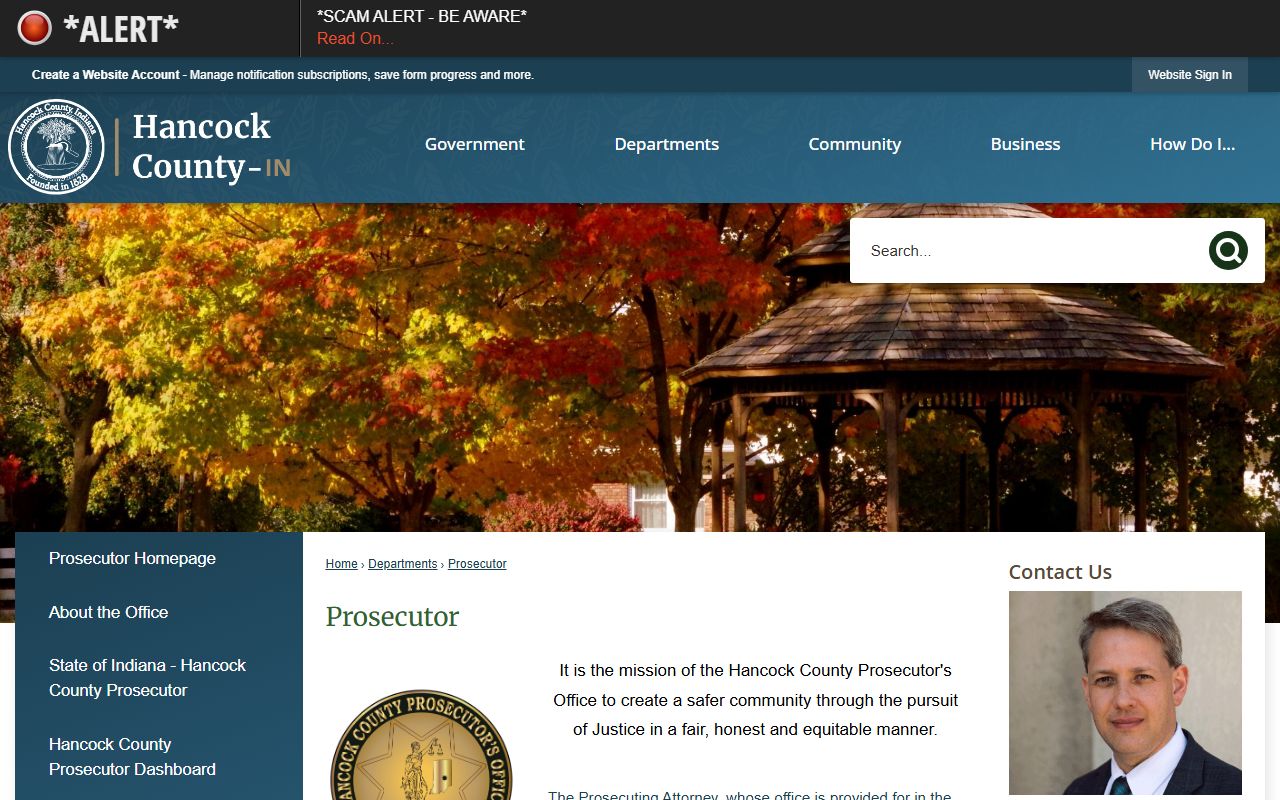
Prosecutor information helps explain who files or pursues criminal charges, while MyCase and the clerk show the court's public case history.
Local criminal records may also show public defender appointment entries. The Hancock County Public Defender Office represents indigent clients in Circuit and Superior Courts for eligible felony, misdemeanor, juvenile, criminal appeal, termination, CHINS, and mental-health commitment matters. The FAQ states that appointment eligibility is determined by the judge. A public defender entry in the docket does not change the record custodian. It shows court-appointed counsel activity within the criminal case.
The prosecutor biography and local initiatives are documented on the county Prosecutor biography page.

Those local initiatives matter because treatment, victim-service, and problem-solving court work can appear later as docket entries, orders, or sentencing terms.
Hancock Criminal Case Outcomes
Not every criminal court record ends with a simple jail or fine entry. Hancock County has local problem-solving and treatment-oriented programs that can affect the docket. The Behavioral Health Court page describes a specialized court for cases where mental health conditions contribute to criminal justice involvement. It emphasizes treatment, accountability, structured support, stability, reduced recidivism, and public safety. The prosecutor biography also describes Brent Eaton as a founding member of the Hancock County Drug Court and active in treatment-focused work for defendants with severe substance-abuse issues.
A docket may show review hearings, compliance checks, probation terms, treatment placement, community corrections, or program-related orders. These entries are part of the criminal court record when the court orders them. They should be read in context with the plea, disposition, sentence, and later compliance history. If a case is confidential, juvenile, sealed, or restricted by rule, public access may be limited even when a program exists.
Hancock Criminal Sealed Records
Indiana law allows eligible criminal records to be restricted through expungement or sealing under IC 35-38-9. Hancock County expungement filings go through the court, not the sheriff or jail. The fee schedule lists expungement as XP and states that if the case did not result in a conviction, was dismissed, or was reduced to an infraction, no filing fee applies. Other expungement filings may carry the listed filing fee. The court decides whether statutory requirements are met.
| Sealed | Expunged | |
|---|---|---|
| Public View | Public access is blocked or limited by court rule, law, or order. | Public access can be removed or restricted after the court grants eligible relief. |
| How It Starts | By confidentiality rule, court order, or statutory restriction. | By petition under Indiana expungement law when the case qualifies. |
| Effect on MyCase | The case, document, or data field may not appear publicly. | The public case view may be removed, limited, or marked according to the order and record type. |
| Where to Ask | The issuing court or clerk, with party identification when required. | The court handling the expungement petition and the clerk for filed case documents. |
Public Access to Hancock Criminal Records
Criminal court records are generally public unless a statute, court rule, or order restricts access. The Indiana Rules on Access to Court Records establish the public-access framework, and Rule 5 identifies categories excluded from public access. The Hancock County Clerk's public-records process provides copies for public records and requires identification for parties to confidential cases. Juvenile records are expressly confidential under the county public-records page.
Key Statutes:
IC 5-14-3 governs public agency records and requires public access unless law makes a record confidential or discretionary to withhold.
IC 31-39 governs Indiana juvenile record access, which is why juvenile criminal-style matters are not ordinary public searches.
The Hancock County Public Defender page is part of the criminal court records image set.
Defense appointment information can appear in criminal case dockets, but the court and clerk still control case record access.
Restricted Hancock Criminal Records
Restricted criminal court records include juvenile matters, sealed cases, expunged cases, confidential documents, personal identifiers, and certain records affected by Indiana Access to Court Records Rule 5. A public search may show no result, or it may show a case without the document the user expects. That does not always mean the case never existed. It may mean access is limited to a party, attorney, agency, or court order.
Background checks have a separate legal context. A casual MyCase search is not the same as a consumer report for employment, housing, credit, insurance, or other FCRA-regulated uses. Users needing an official criminal-history product should use the proper authorized channel and verify whether the record is complete, current, expunged, restricted, or limited by law.
Important: Public court lookup is not an FCRA consumer report and should not be used for regulated screening.
The county's Public Defender FAQ is also assigned to the criminal court records page.
The FAQ is most useful for understanding appointment requests and case-information paths, not for obtaining certified criminal court records.