
What Hancock County Dockets Show
A docket is the court's running log of case events. In Indiana MyCase, that log is usually called the chronological case summary. For Hancock County court dockets, it can show the date of a filing, the type of entry, the party or attorney involved, hearing notices, orders, continuances, dispositions, sentencing entries, and payment or bond events where public. A docket helps track what happened and what may happen next, but it does not always include the full text of each motion, exhibit, order, or document.
The full case file is broader. A case file may include pleadings, motions, exhibits, orders, judgments, sentencing documents, public downloadable documents, and documents that are not online. Docket entries tell users that an event occurred. The underlying document may require a MyCase document link, party access, attorney access, or a request to the Hancock County Clerk. Certified docket copies and certified case documents come from the clerk, not from a screenshot of an online docket.
The local courts connected to Hancock County court dockets are Hancock Circuit Court, Hancock Superior Court I, and Hancock Superior Court II. Circuit Court handles probate, criminal, civil, juvenile, and domestic relations matters. Superior Court I has broad general jurisdiction, including serious felony criminal cases, divorces, juvenile delinquency, CHINS, auto accidents, negligence actions, estates, foreclosures, and evictions. Superior Court II handles traffic infractions, misdemeanors, Class D felonies, and small claims.
Find Hancock County Court Dockets Online
Public Hancock County court dockets are searched through Indiana MyCase. The Indiana Judicial Branch Hancock County page sends users to MyCase for court case search, while the clerk remains the source for copies that are not available online. MyCase can be searched by case number, citation number, cross-reference number, party name, business name, or attorney. For docket work, a known case number is best because it opens the exact chronological case summary instead of a list of possible matches.
- Open Indiana MyCase and choose the search mode that matches the information available.
- Enter the case number, citation number, party name, business name, or attorney information.
- Narrow to Hancock County or the proper court if the result set is too broad.
- Open the case result and find the chronological case summary or docket section.
- Check hearing entries, orders, motions, disposition entries, sentencing entries, and document links.
- Contact the Hancock County Clerk when a docket references a document that is not downloadable or when a certified copy is needed.
The Indiana ePay public access portal appears in the docket manifest because payments can be tied to court cases and traffic cases.
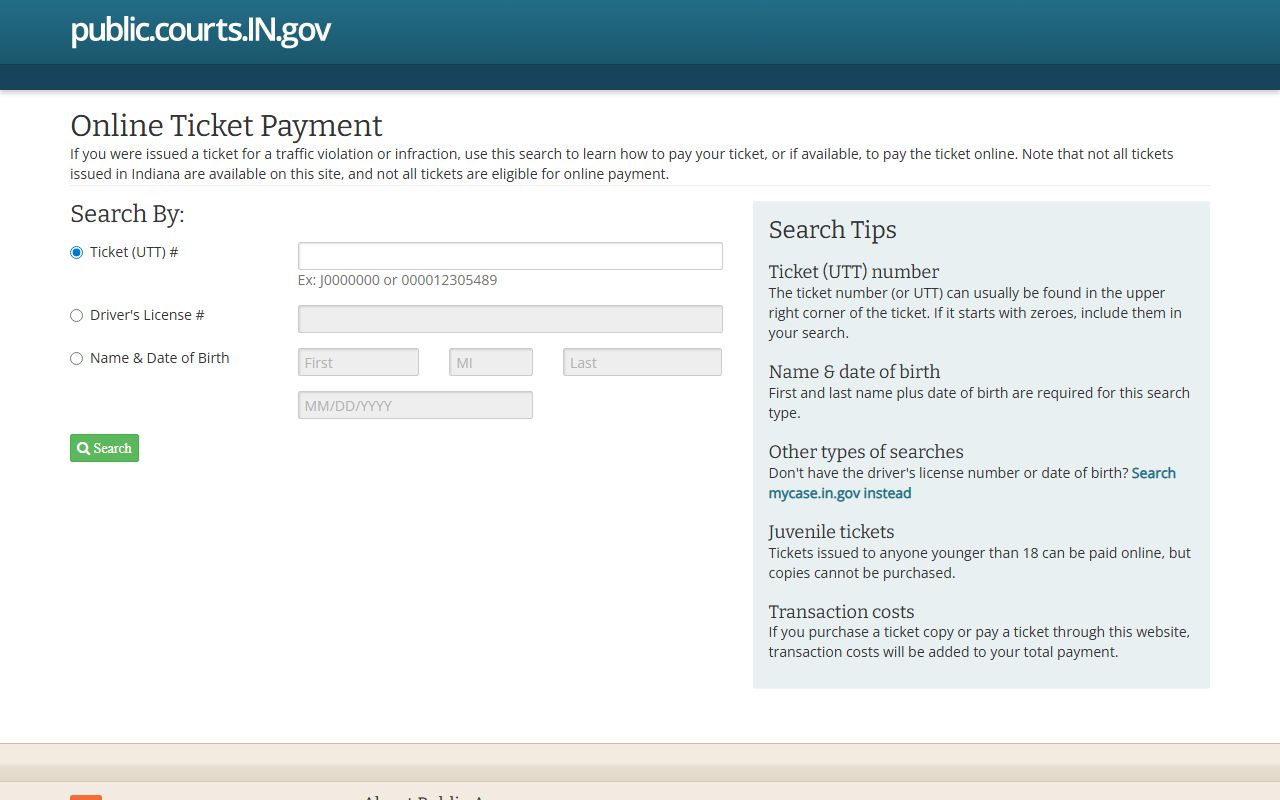
Payment portals can help with due amounts, but the case docket in MyCase remains the better place to read hearing events, orders, and case status.
Sample Hancock County Docket Entry
The research file identifies the docket fields most often visible in the MyCase public view. The exact fields vary by case type and access level, but the chronological case summary usually focuses on event dates and event text. In criminal cases, docket entries can show initial hearing, bond, plea, sentencing, and warrant-related events if public. In civil and probate cases, docket entries may show complaint filed, summons issued, service returned, motion filed, order entered, hearing set, judgment entered, or letters issued.
| Field | What It Shows |
|---|---|
| Entry Date | The date the filing, hearing, order, notice, payment, or other event was entered on the court record. |
| Event Description | The short docket text, such as motion filed, order entered, hearing scheduled, continuance, judgment, sentencing, or disposition. |
| Party or Filer | The party, attorney, prosecutor, clerk, court, or other filer associated with the entry when shown. |
| Document Title | The title of a linked public document when the court system makes the document available online. |
| Hearing Details | Hearing type, hearing date, status, judicial officer, courtroom, or related scheduling information when public. |
| Disposition or Judgment | The case outcome, charge outcome, judgment event, sentence entry, or other result when entered and public. |
Hancock Courts with Public Dockets
Hancock County court dockets should be read with the court assignment in mind. The clerk keeps the record across the local courts, but the judge controls the calendar and case orders. The clerk's court-information page states that the court, not the clerk, establishes the court calendar, so clerk staff may provide records and copies but may not know when a judge will act in a matter. That is an important distinction for users checking whether a motion has been ruled on or when a case will be called.
| Court | Location | Phone | Docket Notes |
|---|---|---|---|
| Hancock Circuit Court | 9 E Main Street, Room 302, Greenfield, IN 46140 | 317-477-1107 | Probate, criminal, civil, juvenile, and domestic relations matters. |
| Hancock Superior Court I | 9 E Main Street, Room 303, Greenfield, IN 46140 | 317-477-1148 | Serious felony, divorce, juvenile, estate, foreclosure, eviction, and general civil matters. |
| Hancock Superior Court II | 9 E Main Street, Room 217, Greenfield, IN 46140 | 317-477-1115 | Traffic infractions, misdemeanors, Class D felonies, and small claims. |
The docket should also be checked for reassignment. Local rules allow random civil case assignment in Circuit Court and Superior Court I under an approved method, with manual assignment when a related case exists. Judges also retain authority to reassign case types between courts when workload or convenience requires it.
Hancock Dockets vs Case Records
For Hancock County court dockets, the most common mistake is treating a docket event as the whole case record. A docket line can prove that an order was entered or a hearing was set, but it may not show the full order text. A full case record may include the complaint, information, petition, motion, exhibit, order, judgment, sentence, or certified document that the docket only names. A docket is a map of events. It is not always the document itself.
| Docket | Full Case Record | |
|---|---|---|
| Format | List of case events in the chronological case summary. | Case documents, orders, filings, exhibits where public, and certified copies. |
| Access | Often searchable online through MyCase when public. | May be online, restricted, older, off-site, or available only through the clerk. |
| Best Use | Track status, hearing dates, filings, and outcomes. | Review exact legal text or obtain proof for filing, appeal, title, employment, or personal records. |
| Official Copy | Online view is public information, not a certified record. | Certified copies come from the Hancock County Clerk. |
Criminal Dockets in Hancock County
Criminal docket entries can show more than a final result. In Hancock County criminal cases, the public docket may show the charging event, initial hearing, bond setting, counsel appointment, pretrial conference, motion filing, plea hearing, trial setting, disposition, sentencing, probation, restitution, or warrant-related event when that entry is public. The full criminal case file and sentence details are handled in the criminal court record, but the docket is often the quickest way to see whether the case is pending, resolved, continued, or set for a future hearing.
Hancock County criminal case codes in the fee schedule include CM for criminal misdemeanor, MC for miscellaneous criminal, F1 through F6 for felony levels, and PC for post-conviction relief. A docket entry with one of those case types does not by itself prove a conviction. It may show only a charge, a pending case, a dismissed count, an amended charge, or a post-conviction filing. The disposition entry is the key line for the outcome.
For federal criminal dockets involving the Southern District of Indiana, local Hancock County clerk staff are not the record custodian. Federal dockets are accessed through Southern District case search information, CM/ECF, and PACER.
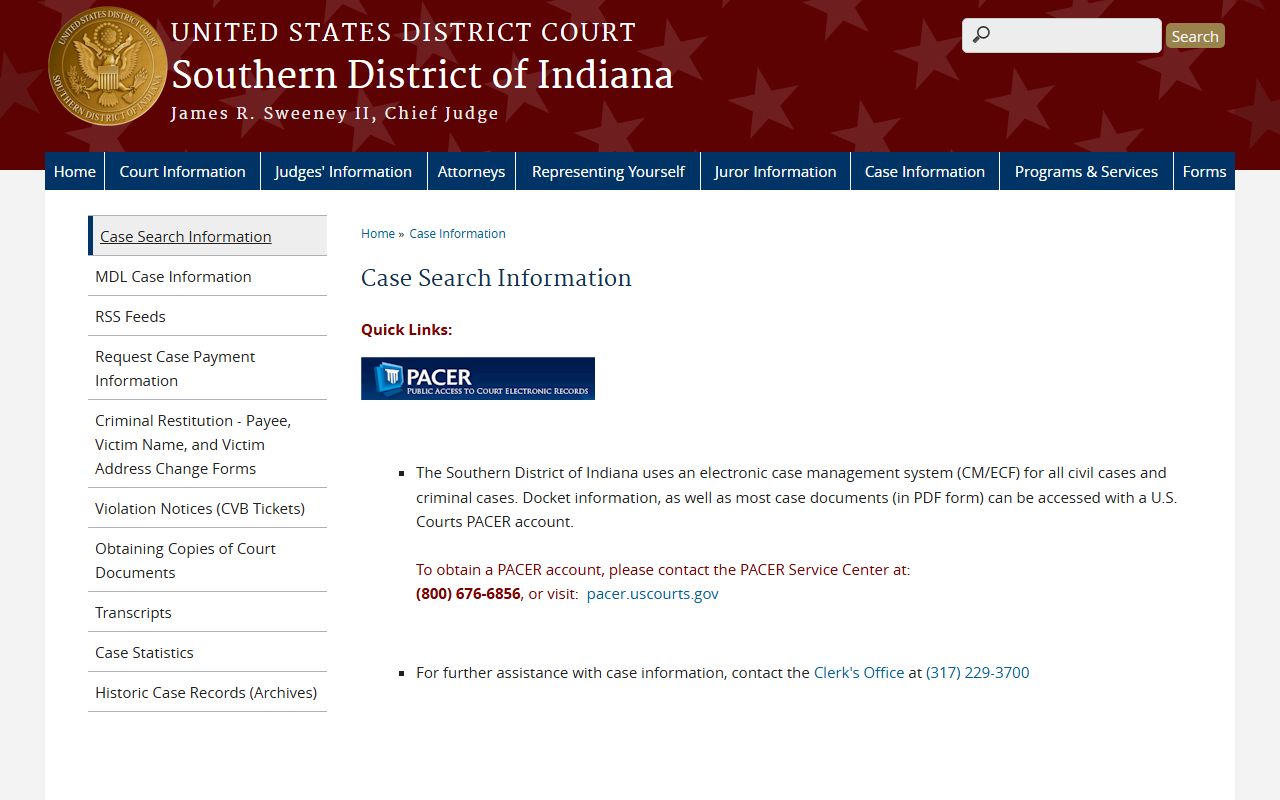
That federal docket channel is separate from Hancock County trial court dockets, even when the person or event has a Hancock County connection.
Read Hancock County Dockets Carefully
Docket terms are short because they are case-management entries. "Motion" means a party asked the judge to take action. "Order" means the judge directed or decided something. "Continuance" means a hearing or deadline was postponed. "Disposition" means the outcome of a charge or case. "Judgment" is the final decision or enforceable result. "Chronological Case Summary" is Indiana's event history for the case.
Some entries need context. A warrant issued entry may later be followed by a recalled, quashed, served, or bond entry. A dismissed charge may exist beside a separate conviction on another count. A hearing date can change after a continuance. A civil judgment may later show satisfaction, garnishment, or collection entries. That is why the full sequence matters more than one line in isolation.
Note: If a Hancock County docket entry names a document that is not online, request the document from the clerk.
The Southern District CM/ECF login page is included in the docket image set for federal access context.
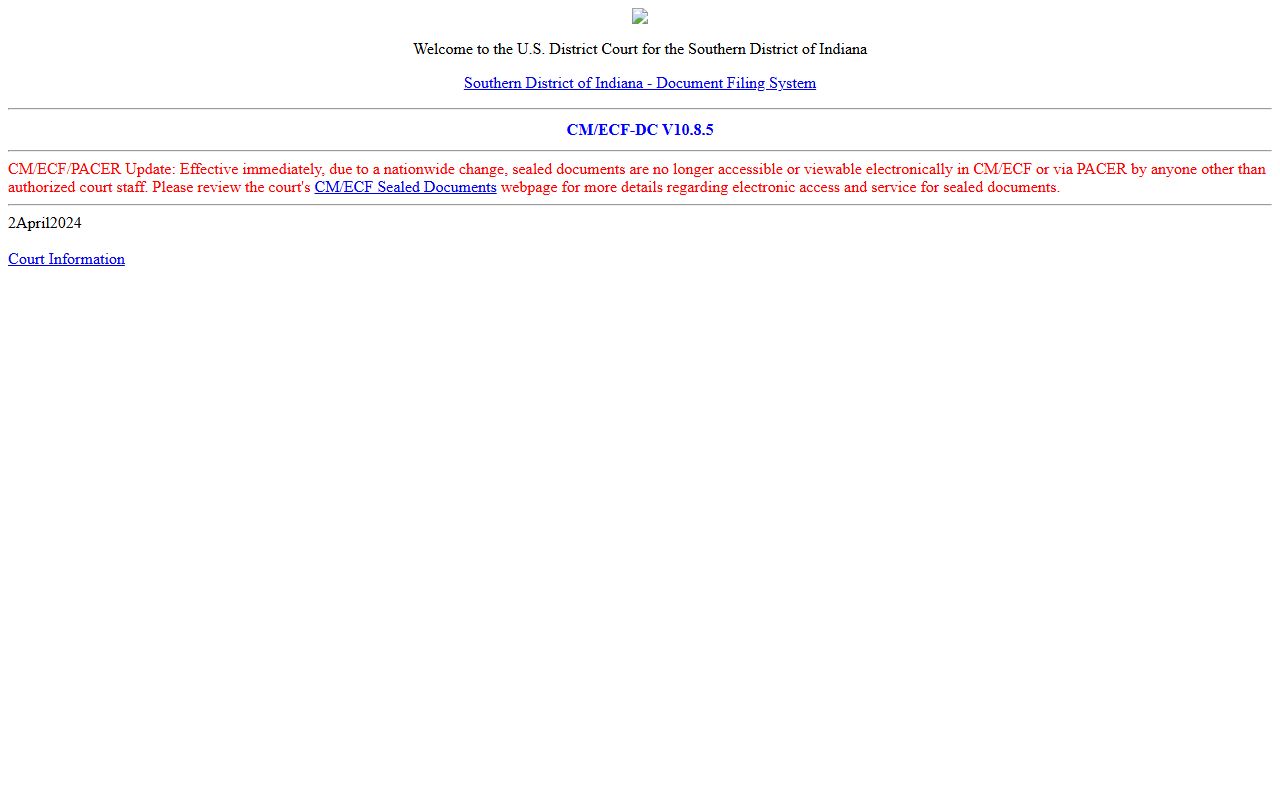
Federal CM/ECF access should not be confused with Indiana MyCase, which is the public starting point for Hancock County trial court dockets.
Official Hancock County Docket Copies
For official docket copies, use the Hancock County Clerk's Public Access Department. The clerk's public-records process requires enough detail to identify the record with reasonable particularity. Provide the case number if known, party names, case type, date range, document title or docket request, and the copy type needed. The clerk lists court case copies at $1 per page and certification at $3 per certification. Mail requests should include a money order and a self-addressed stamped envelope.
The Request for Information form states that in-person requests may take up to 24 hours and mail requests may take up to seven days. Closed case files may be held off-site and may not be available until the next business day. If the case is juvenile, confidential paternity, adoption, mental health, sealed, or otherwise restricted under Indiana access rules, public docket access may be limited and parties may need photo identification.