
Hancock County Clerk Office
The official Hancock County Clerk of Courts page identifies Lisa M. Lofgreen as the elected clerk. Indiana treats the clerk as a constitutional officer, elected for a four-year term, with a term-limit rule that prevents more than eight years of service within a twelve-year period. In Hancock County, this is a unified office, so there is no separate district clerk or split county clerk for court records.
The clerk is the keeper of records for the Hancock Circuit Court, Hancock Superior Court I, and Hancock Superior Court II. The office issues marriage licenses, collects court-related fees and fines, maintains child-support payment records, handles certified court-document requests, and also has election-board duties. Because the clerk handles public funds, the research notes that the office is audited annually by the State Board of Accounts.
Hancock County Clerk
Clerk: Lisa M. Lofgreen
9 E Main Street, Room 213
Greenfield, IN 46140
317-477-1109
lisa.lofgreen@hancockin.gov
Monday-Friday, 8 a.m.-4 p.m.
Hancock County Clerk Duties
The clerk's duties combine court-record access with day-to-day court administration. The office can accept filings from self-represented litigants by approved channels, collect filing and copy fees, provide certified copies when the record is available, and process written public-record requests. The clerk's court-information page also cautions that staff can assist with access to the judicial system, but they cannot give legal opinions or legal advice.
- Maintain court records for Hancock Circuit Court and Hancock Superior Courts.
- Issue marriage licenses and certified marriage copies.
- Collect court fees, fines, copy fees, certifications, and some child-support payment records.
- Process public record and copy requests through the Public Access Department.
- Receive allowed filings in person, by mail, by fax, or through e-filing where required.
The clerk court-information page notes one key limit: the court, not the clerk, sets the court calendar. That means the clerk can help locate the record and provide copies, but hearing dates, rulings, and action on pending matters are controlled by the judge.
The official clerk page is the lead source for Hancock County Clerk contact details and duties.
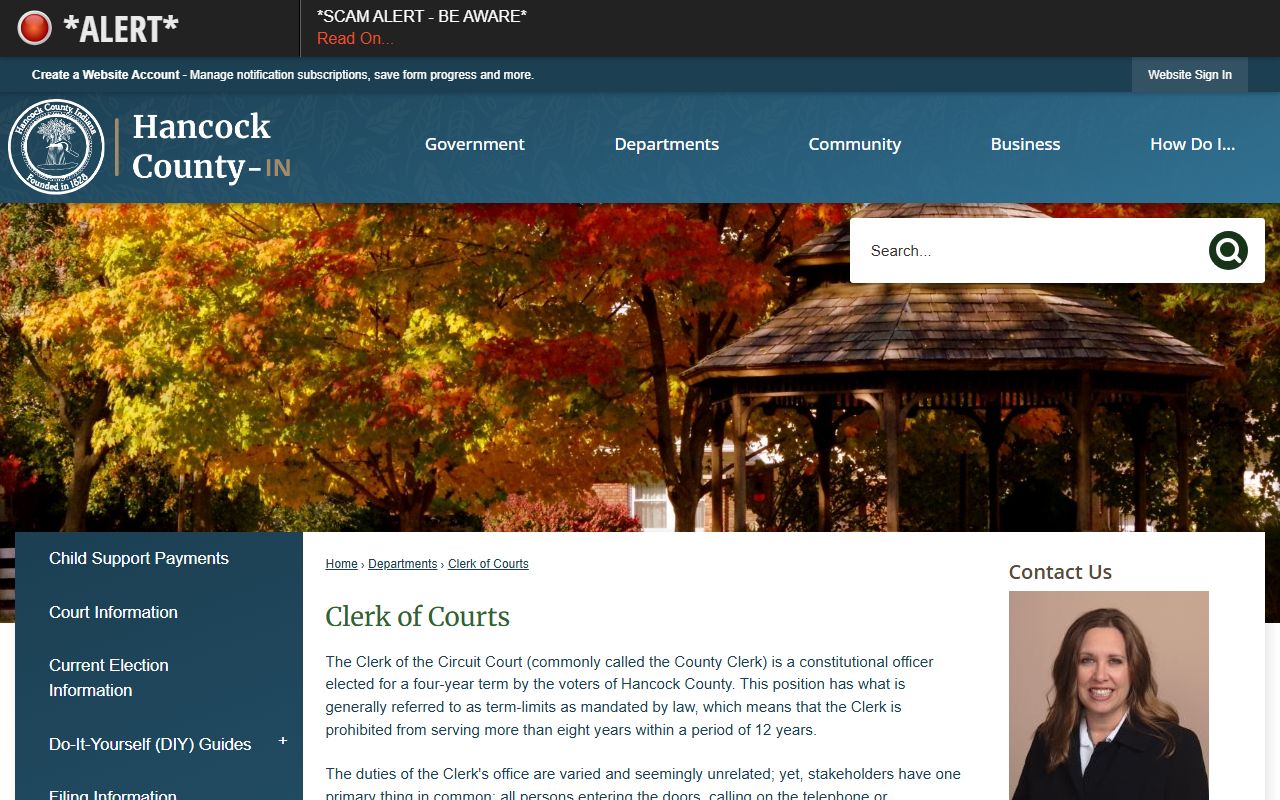
The office page is the best starting point when a user needs the clerk's room number, phone number, hours, email, and general service list.
Request Hancock County Certified Copies
Certified copies are official clerk-issued copies used when a plain printout is not enough. Common examples include certified divorce decrees, certified court orders, certified probate letters, certified judgments, and other court documents needed for legal, financial, or agency use. MyCase may show public information and some documents, but the county clerk issues the official copy and applies the certification fee.
- Identify the case by case number if possible. If not, use party names, case type, filing year, document name, or any other facts that make the record reasonably specific.
- Check Indiana MyCase first for public case data, court name, case number, filing date, parties, and document names.
- Use the Request for Information form for a written request, or visit the room 213 clerk counter during posted hours.
- Include the copy fee, certification fee, and a self-addressed stamped envelope for mail requests. The clerk's public-records page says written requests should include a money order.
- Allow for response timing. The request form says in-person requests may take up to 24 hours, mail requests may take up to seven days, and closed files may be off-site until the next business day.
Hancock County Request Fields
The clerk's Request for Information form asks for requester identity, contact information, request channel, response channel, copy need, and a clear description of the public record. The form cites Indiana's reasonable-particularity requirement, which means a request should describe the record well enough for staff to locate it.
| Field | Required | Notes |
|---|---|---|
| Date of request and time | Implied | Blank lines identify when the request was made. |
| Request made | Office use / channel | Checkboxes for in person, by mail, or by fax. |
| Information provided by | Office use / response | Checkboxes for pick-up, by mail, or by email. |
| Copies required | Yes | Checkboxes for no or yes. |
| Name of citizen requesting information | Yes | Full requester name. |
| Address, city, state, ZIP, and daytime phone | Yes | Mailing and contact information. |
| Record requested | Yes | Describe the public record with reasonable particularity. |
| Signature | Yes | Signature of the person filing the request. |
The county's Public Records Request page is the local source for court copy requests, confidential-case limits, copy fees, and certification fees.
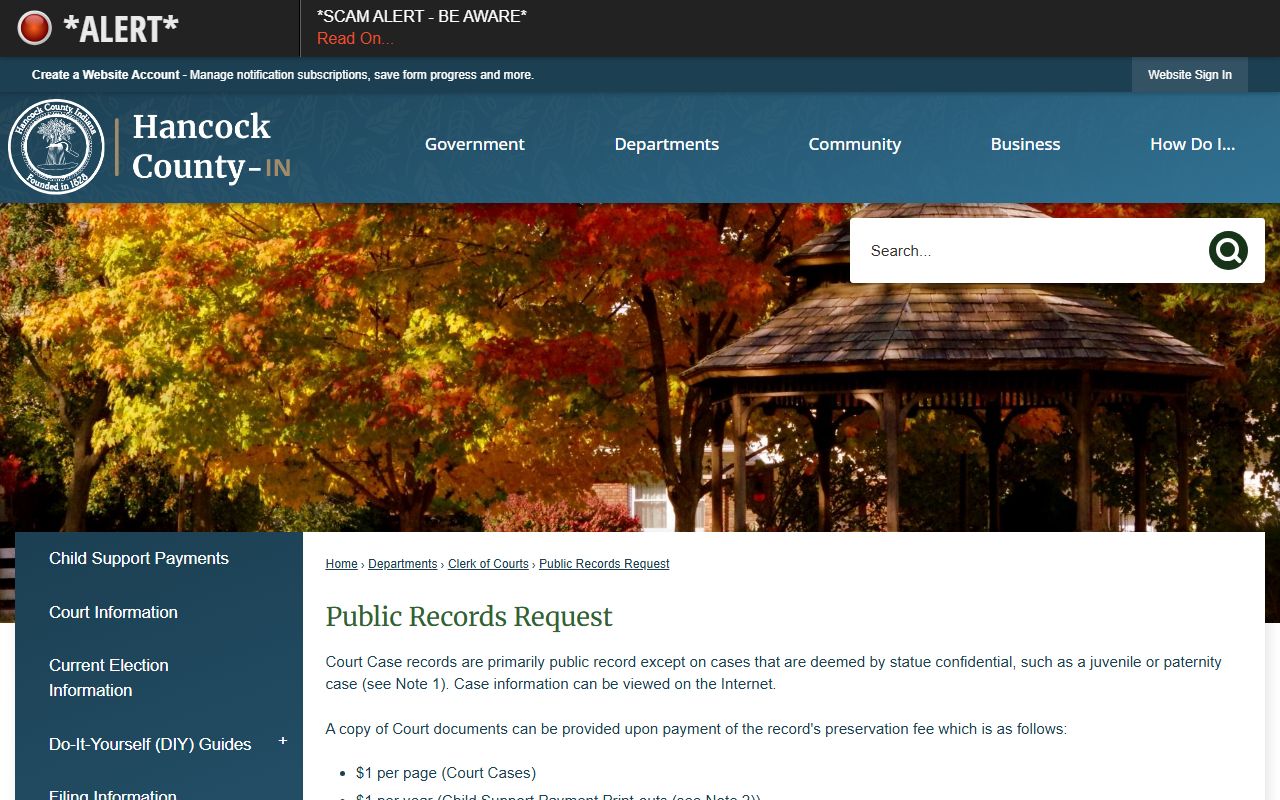
That public-records page is also where users see the mail-request route for court documents that are not available online.
Hancock County Clerk Fees
Hancock County clerk fees vary by service. The public-records page lists copy and certification amounts, while the county court fee schedule lists filing fees by case type. Filing fees are separate from copy fees, so a person asking for a certified copy should not use a new-case filing amount unless they are also starting a court case.
| Item | Amount / rule |
|---|---|
| Court case copies | $1 per page |
| Child support payment printouts | $1 per year |
| Certification | $3 per certification |
| Microfilm copies | $1 per page |
| Civil collection | $157 certified mail / $185 sheriff |
| Civil plenary or civil tort | $232 certified mail / $260 sheriff |
| Domestic relations | $157 certified mail / $185 sheriff |
| Small claims | $97 certified mail / $125 sheriff |
| Estate, including small estate affidavit | $177 certified mail / $205 sheriff |
| Guardianship or trust | $177 |
| Additional certified copies of letters | $2 |
| Post-judgment sheriff service / new filing | $28 |
The court-information page is a key source for copy fee details and court-access limits.
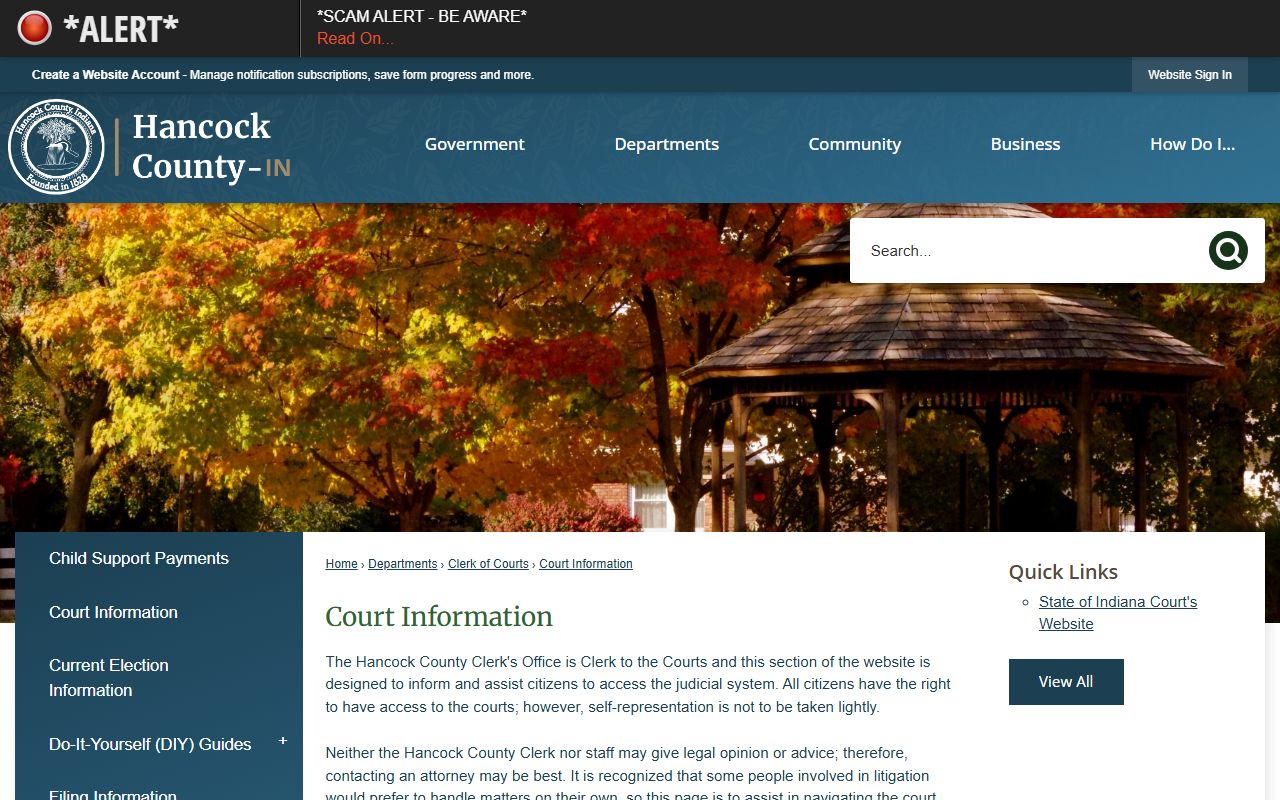
Fee details should be checked against the current clerk page before payment because filing fees and service rules can change by court order or state schedule.
Hancock County Clerk Forms
Hancock County record and filing work uses different forms and channels depending on the request. A record-copy user usually needs the Request for Information form. A self-represented filer may use in-person, mail, or fax filing where allowed. Attorneys must use an Indiana E-Filing Service Provider for new cases and later filings because Hancock County courts have begun electronic filing by order of the Indiana Supreme Court.
- Request for Information form for court copies, certifications, and public-record requests.
- Filing Information for in-person, mail, fax, and e-filing channel rules.
- Hancock court fee schedule for filing, copy, certification, probate, civil, and expungement fees.
The filing-information page explains how filings reach the clerk and states that email filings cannot be accepted.
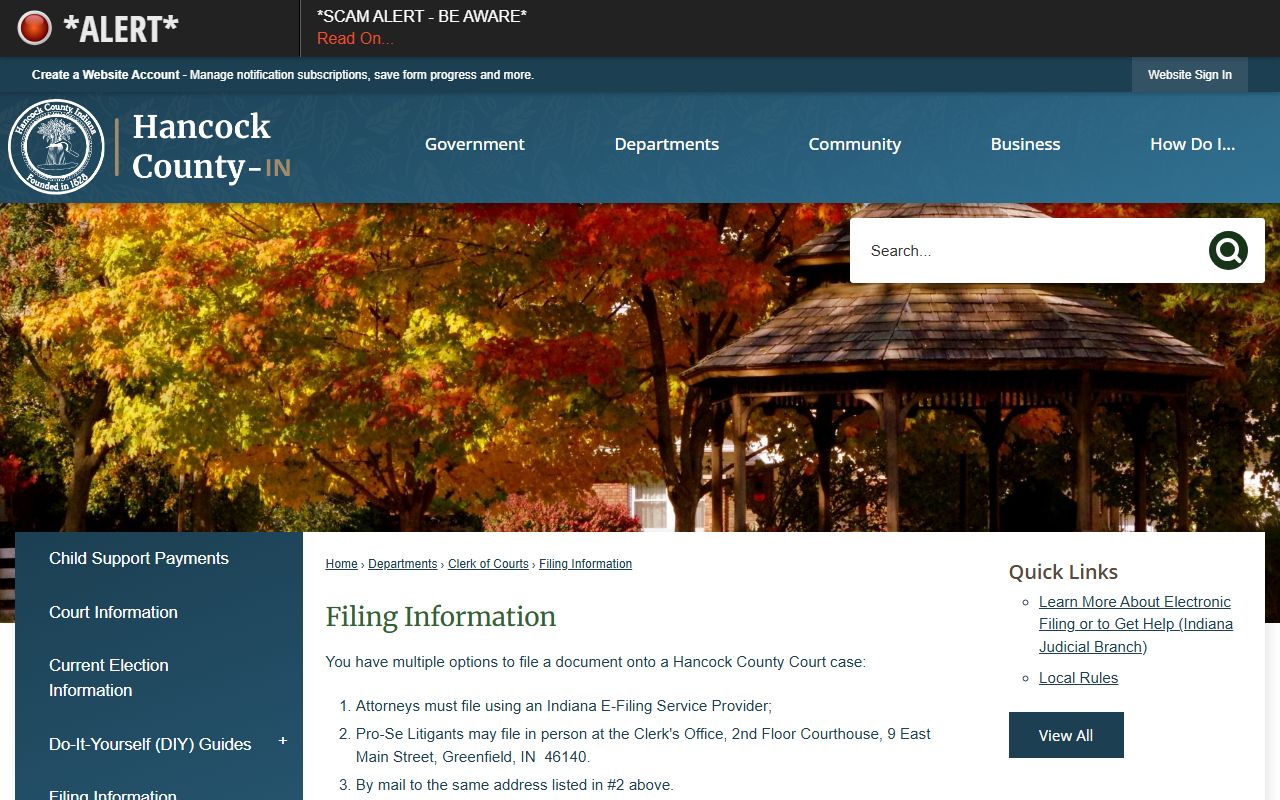
That filing distinction matters because sending a pleading by email can fail even when a public-record question can be handled through another written channel.
Hancock County Filing Channels
Filing and record-copy channels should not be mixed. Attorneys file through e-filing providers. Self-represented litigants may file in person at the second-floor clerk counter, by mail to the clerk, or by fax to 317-477-1163 where allowed. The filing page says email filings cannot be accepted. New cases are assigned according to Hancock County local rules and court authority, not by a user's personal choice of courtroom.
Public records and certified copies use the clerk's Public Access Department. Mail requests go to Hancock County Clerk, Public Access Department, 9 E Main Street, Room 213, Greenfield, IN 46140. The request should include the form, enough information to identify the record, payment by money order when required, and a self-addressed stamped envelope for return mailing.
Note: The clerk can provide access and copies, but cannot advise which form to file, what claim to make, or how a judge will rule.